When you purchase detector gear through links on Ground Phase, we may earn an affiliate commission at no extra cost to you. How Ground Phase earns referral fees
Metal detecting around aquatic environments turns up some of the most sought-after recoveries—from jewelry lost in surf break to old coinage trapped in river gravel. However, operating in or near water carries an unforgiving physical reality: water ingress destroys unsealed electronic control circuitry immediately. Before taking any detector into wet sand, whitewater streams, or deep surf, detectorists need to separate broad marketing claims of "waterproof" from verified ingress protection ratings and housing designs.
A "waterproof search coil" does not make an entire detector submersible. On full-sized detectors, search coils are routinely epoxy-potted and waterproof, but the upper stem, display screen, speaker housing, and battery chassis are often merely weather-resistant. Submerging the control unit beyond its intended rating will flood the processor.
Water Depth Zones: Matching Gear to the Environment
Selecting water-capable equipment depends primarily on the physical water column you intend to work. As outlined in the Metal Detecting Tips guide to underwater metal detecting, wet hunting falls into three distinct operational tiers:
- Ankle-to-Knee Wading: Searching surf margins, tidal wash zones, and stream shallows. Here, only the lower shaft and search coil enter the water. Standard machines with sealed coils handle this easily, provided the control box remains completely clear of rogue waves and splash zones.
- Chest-Deep Hunting: Pounding surf lines and lake swimming areas where waves, current, or sudden drops make total immersion inevitable. In this zone, both the processor housing and headphone connection must be rated for continuous water exposure.
- Submerged Snorkeling and Scuba: Searching river bottoms, reefs, and seabed depressions. This requires specialized fully submersible compact detectors or dive-specific pinpointers designed to withstand hydrostatic pressure.
According to Garrett's analysis on underwater detector operation, magnetic fields penetrate water just as they do air and soil, but environmental conductivity introduces complications. In freshwater, signals travel predictably. In saltwater, however, dissolved sodium chloride makes the water itself conductive, which causes unshielded or single-frequency VLF (Very Low Frequency) circuits to chatter continuously unless ground-balanced or detuned. For underwater beach and ocean exploration, pulse induction (PI) circuitry or multi-frequency processing is typically required for stable operation.
Evaluating Submersible Pinpointers and Compact Dive Probes
Handheld pinpointers and miniature dive detectors serve two critical underwater functions. In murky riverbeds or stirred-up ocean silt, zero visibility often forces detectorists to feel targets by hand; a compact vibrating probe pinpoints coins or rings hidden beneath sediment layers without requiring bulky digging tools. Compact dive coils also provide a portable primary detector for snorkelers swimming through narrow kelp beds or rocky crevices.
When shopping for direct-import and value-tier handheld detectors, advertised specifications must be inspected critically. Many listings use titles combining terms like "waterproof," "underground," and "submersible," but their actual construction may range from basic splash resistance (protected battery caps with thin rubber seals) to fully potted dive casings with magnetic switches.

Verify actual seal type and operating kHz suitability for local wet-salt or mineralization conditions prior to deployment.
The Treasure Hunter GP Pointer (Product 1) is marketed as a handheld pinpointer offering 360-degree side scanning and target proximity alarms. The listing promotes features such as an LED locator light, auto-shutdown, and a rechargeable battery system. However, marketplace listings do not provide an independent laboratory ingress test (such as an IP68 certification sheet). Buyers planning to submerge wand-style pointers in streams or wet shoreline sand should carefully examine the charging port and battery compartment seals prior to exposing the unit to standing water.
Verify actual seal type and operating kHz suitability for local wet-salt or mineralization conditions prior to deployment.
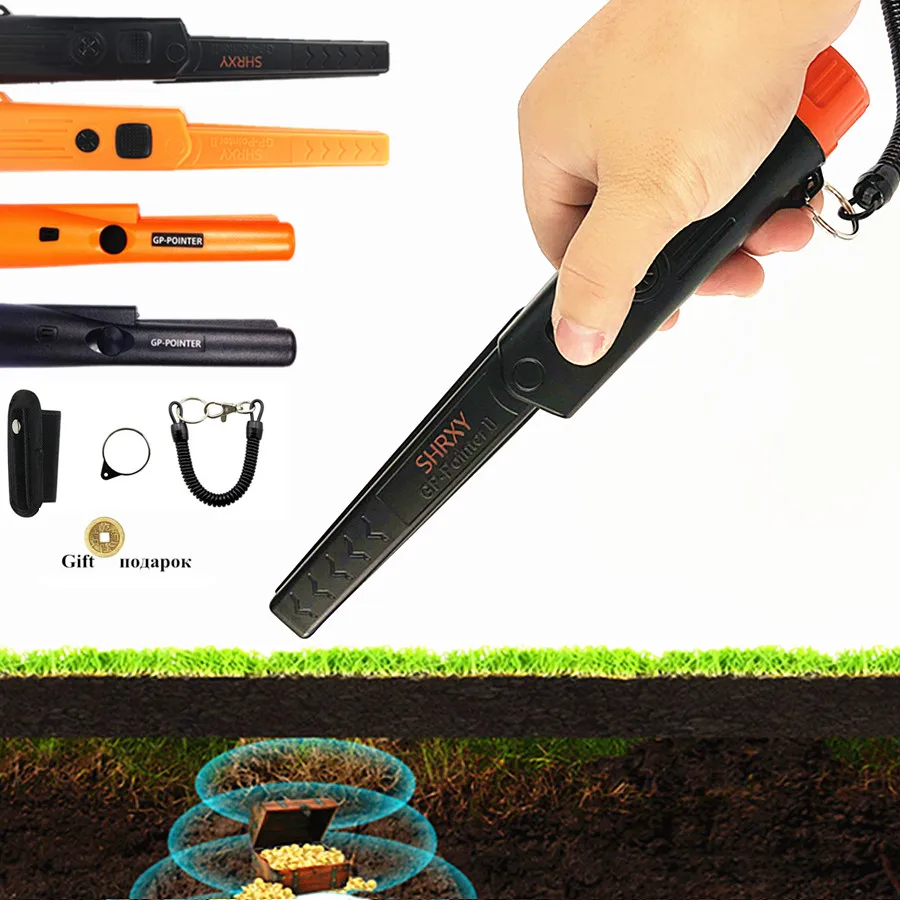
The GP-pointerII Hand Held Metal Detector (Product 2, listing branding showing SHRXY GP-Pointer II markings) is an entry-level wand probe packaged with an attachment bracelet. Pointers of this geometry are widely utilized for land-based dirt plugging and shallow riverbed gravel triage. While the seller listing states "waterproof," buyers should verify whether water sealing applies exclusively to the probe tip and casing body or if the rear screw cap can reliably resist hydrostatic pressure when submerged beneath the surface.

Verify actual seal type and operating kHz suitability for local wet-salt or mineralization conditions prior to deployment.
For detectorists moving past wand-style probes into shallow submerged search sweeps, the Treasure Hunter GT120 Handheld Diving Metal Detector (Product 3) incorporates a 4.2-inch circular search loop on a handheld wand. The seller advertises this unit with an IP68 rating, an anti-loss chain, and adjustable sensitivity specifically for diving. An expanded coil diameter increases scan surface area compared to narrow cylindrical probes, making it a functional bridge tool for snorkelers working river bottoms or surf troughs. Buyers must ensure the battery cap threads are cleaned and lubricated with silicone grease before diving, as sand grains caught on the seal can breach water resistance.

Verify actual seal type and operating kHz suitability for local wet-salt or mineralization conditions prior to deployment.
Listing Product 4 presents a handheld positioning rod detector described as a high-precision digger tool for outdoor treasure hunting. The seller listing photography displays packaging and housing featuring "Garrett Pro-Pointer" markings, priced in the budget utility segment ($23.99 reference price). When purchasing third-party marketplace listings where branding in photos may differ from official distribution channels, buyers should inspect the unit upon delivery to confirm build authenticity, component fit, switch dampening, and the integrity of the O-ring seal along the battery cap.

Verify actual seal type and operating kHz suitability for local wet-salt or mineralization conditions prior to deployment.
The 2022 Underwater Dive Scuba Metal Detector (Product 5) features an adjustable folding search coil mounted to an ergonomic handle. The seller advertises folding waterproof coil geometry with pulse scan functionality for dive and scuba hunting. Folding paddle or oval coils allow divers to glide close across underwater reefs, sand ripples, and lakebeds with reduced hydrodynamic drag compared to standard full-length shafts. As with any pulse or continuous-immersion tool, checking the manufacturer's exact operational depth limit before submerging beyond snorkel depths is essential.
Pre-Immersion Verification Checklist
- Inspect the O-Ring: Remove the rear battery cap and look for an intact, flexible rubber or silicone O-ring. If the gasket is dry, cracked, or pinched, replace it or coat it with pure silicone grease before immersion.
- Check Switch Sealing: Underwater detectors generally employ rubberized membrane switches or magnetic reed switches. Unsealed mechanical toggle buttons or loose slider switches will allow water intrusion under pressure.
- Rinse with Fresh Water: Salt crystals and fine beach quartz are abrasive. After any saltwater or brackish session, thoroughly soak and rinse the sealed exterior in clean tap water before unscrewing battery compartments.
- Perform a Shallow Sink Test: Before trusting a new handheld detector on a deep dive, submerge it in a bucket or sink of shallow tap water for 15 minutes without movement. Inspect the battery chamber for any sign of micro-droplets or condensation.
Operational Differences: Freshwater vs. Saltwater Exploration
Water chemistry plays an enormous role in whether a detector yields clean signals or overwhelming phantom chatter. In freshwater lakes, mountain streams, and rivers, mineralization is usually low (unless hunting in black-sand heavy gold-bearing creeks). Standard VLF pinpointers and handheld probes work reliably in freshwater, discriminating iron trash from non-ferrous jewelry without severe tuning issues.
Saltwater environments are entirely different. The combination of dissolved mineral salts and saturated wet sand turns the ground into an active electrical conductor. When a standard VLF coil moves over conductive saltwater, the phase shift mimics a large target, causing continuous falsing. While specialized full-size beach machines use simultaneous multi-frequency (SMF) or pulse induction (PI) to ignore conductive salt brine, budget handheld pointers vary significantly. When taking handheld probes into breaking ocean surf, prepare to reduce sensitivity settings or retune the unit against the wet sand surface to minimize salt ground noise.
Delivery and SKU Verification for Online Orders
Budget handheld metal detectors and diving probes are frequently distributed via global marketplace platforms with inventory variations across regions. Stated reference prices and feature packages—such as included coiled lanyards, belt holsters, or battery configurations—are subject to frequent merchant revisions.
Listing availability was recorded across primary distribution channels including the United States, Mexico, Switzerland, Canada, Brazil, South Korea, Japan, and Thailand. Because shipping policies, local tax assessments, and included hardware vary by seller storefront, always verify the exact variant, package contents, and local return coverage at checkout before deploying equipment to wet environments.
Evaluation is based on published specifications and seller listings. No physical or hands-on testing was conducted; unlisted specifications may still be available from the seller.
